Sign In
Upcoming Event
 Free Newsletter

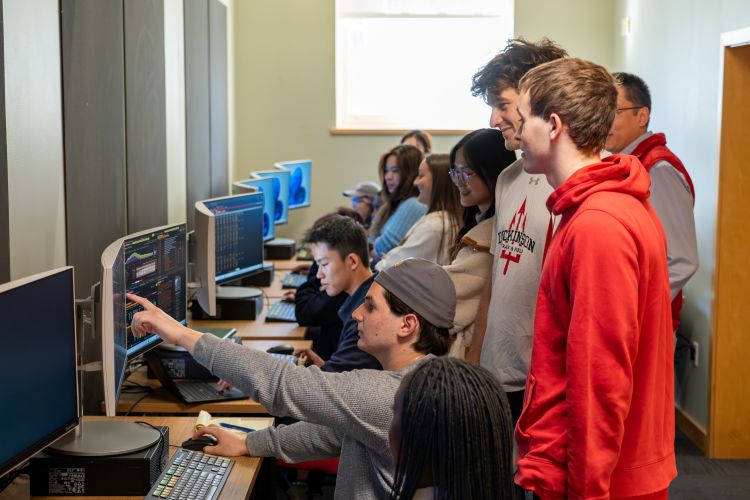
Students use Bloomberg Terminals in Dickinson's new Bloomberg Finance Lab. DAN LOH/DICKINSON COLLEGE
Dickinson College to launch distinctive finance major


Dickinson College announced the launch of a distinctive finance major.
The new major is designed to prepare students for modern financial markets through an interdisciplinary liberal-arts education. The program will officially welcome its first group of students in the fall of 2026.
“Dickinson has always prepared students not just for their first job but for a lifetime of meaningful work and engaged citizenship,” Dickinson College President John E. Jones III said. “The finance major is the next step in that commitment, giving students the analytical tools and critical-thinking skills to lead in this field, in a way only Dickinson can.”
Dickinson’s finance major is aimed at integrating international business, economics, accounting, and mathematics with an interdisciplinary thread. Students will be required to examine financial systems through the lens of the humanities or social sciences, fostering critical thinking and ethical reasoning essential for a rapidly shifting job market.
The college notes that the new finance program arrives as the financial sector increasingly seeks graduates who possess both analytical depth and the ability to navigate a volatile global landscape, per the release. Finance degrees from liberal-arts institutions account for just 1.4% of such degrees granted nationally.
The curriculum is supported by the college’s Burgess Institute for the Global Economy and emphasizes practical application alongside academic theory. The major has a required experiential learning component, ensuring graduates enter the competitive financial workforce with real-world credentials and internship experience.
The Burgess Institute for the Global Economy is an academic and co-curricular accelerator for business fluency and global leadership. It is designed to equip students, regardless of their major, with access to the networks, insights and applied experiences that provide an inside track to careers in business and finance.
Dickinson has also invested in Bloomberg Terminals, which the college calls “one of the most powerful tools in the financial world.” The terminals add another step in preparing students to have an impact on a data-driven world.
These terminals bring real-time global data right into the classroom, giving students hands-on experience with the same technology used by top professionals in finance, policy, and research.
“The vast datasets of the Bloomberg Terminals will allow for a multitude of use cases among different disciplines, especially business students,” said Bloomberg student consultant Duc Le. Le noted that students can use the terminals for their own research while familiarizing themselves with the industry-standard tool.
“This could give them a great edge in recruiting and also cut down on training times in their internships,” said Le.
Bloomberg for Education partners with more than 1,200 schools around the world, offering interactive tools, certification programs like Bloomberg Market Concepts and Environmental, Social, Governance (ESG) and competitions such as the Global Trading Challenge. Now they’ve become the latest tool Dickinson students can use to enhance their liberal-arts education and start careers in finance and related fields.
“Alongside Dickinson’s effort to connect students with alumni in finance, [the terminals] can accelerate Dickinson’s presence on Wall Street,” said Le, who added that students in other disciplines, such as economics, data analytics, law & policy and environmental science, can also benefit.
“In general, the robust data and intelligence on the Bloomberg Terminals will allow new discoveries and enhanced research for Dickinson students.”
The terminals have been installed in Althouse Hall in the new Bloomberg Finance Lab, the Quantitative Reasoning Center and in the Waidner-Spahr Library, and another will be installed soon in the Center for Career Development.
“Bloomberg Terminals bring the world’s financial data into the classroom, allowing students to connect global trends with critical thinking,” said Burgess Executive Director Steve Riccio, who added that the terminals will turn classroom concepts into real-world insights.
“It’s a powerful resource to combine with a liberal-arts education to develop informed, agile thinkers ready to solve complex, real-world problems,” added Riccio.