Sign In
 Free Newsletter

Shapiro Admin leads coalition opposing fed rule on worker misclassification

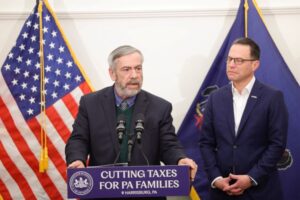
L&I Secretary Nancy A. Walker said worker misclassification has real consequences for wages, workplace protections, and fair competition. PHOTO/PACAST
Shapiro Admin leads coalition opposing fed rule on worker misclassification


 Listen to this article
The Shapiro Administration is leading a coalition challenging a federal rule that opponents believe will weaken worker protections by easing misclassification as independent contractors.
The coalition consists of 22 attorneys general, state labor agencies, and city labor agencies in submitting comments opposing a federal rule that would make it harder for workers to be considered “employees” under federal law, weakening wage protections, undercutting workers’ rights and shifting more costs onto workers and states.
The multi-state coalition is co-led by the Minnesota Attorney General’s Office, opposing the U.S. Department of Labor‘s proposed rule which would weaken workers’ rights by dramatically altering independent contractor status under federal law. The proposal would replace the current federal framework with a narrower approach that would substantially decrease federal labor protections for workers.
“Pennsylvania workers should not lose basic protections because an employer can get away with calling them an independent contractor,” Pennsylvania Labor & Industry Secretary Nancy A. Walker said in a statement. “Worker misclassification has real consequences for wages, workplace protections, and fair competition. When employers are allowed to sidestep labor standards and insurance obligations, workers are harmed, responsible employers are put at a disadvantage, and all taxpayers are left to absorb the cost.
“Governor Shapiro is making clear that Pennsylvania will continue standing up for workers and for businesses that play by the rules.”
L&I enforces Pennsylvania labor laws through the Bureau of Labor Law Compliance, including the Pennsylvania Minimum Wage Act, the Wage Payment and Collection Law, the Prevailing Wage Act, the Seasonal Farm Labor Act, and the Child Labor Act. Workers who believe they have been underpaid can file a complaint online with L&I, and the Department will continue investigating complaints and pursuing wages owed under Pennsylvania law.
Worker misclassification occurs when an employer treats a worker who should legally be considered an employee as an independent contractor, which can deny that worker wages, overtime, leave, workplace protections, and other rights tied to employee status.
According to a release, that change would have significant consequences for workers and employers. Workers who qualify as independent contractors lose access to federal minimum wage and overtime protections, as well as other rights tied to employee status under the Fair Labor Standards Act, the Family and Medical Leave Act, and the Migrant and Seasonal Agricultural Worker Protection Act.
The coalition’s comment explains that the proposed rule would also create confusion for employers and state and local enforcement agencies by reviving a standard from the first Trump Administration that departs from decades of case law and longstanding practice. The proposed rule would also encourage misclassification, when employers treat workers who qualify as employees as independent contractors instead.
The comment, drafted by L&I and the Minnesota Attorney General’s Office, argues that the proposal is unlawful, does not reflect the realities of today’s workplace, and would worsen an already serious misclassification problem by making it easier for employers to avoid payroll taxes, minimum wage and overtime requirements, and other obligations that law abiding employers adhere to.
States and agencies joining the comment include the Attorneys General of Arizona, California, Colorado, Connecticut, the District of Columbia, Hawai’i, Illinois, Massachusetts, Michigan, New Jersey, New York, Oregon, Rhode Island, Vermont, and Washington; the Minnesota Department of Labor and Industry; the Oregon Bureau of Labor and Industries; the Washington State Department of Labor & Industries; the Philadelphia Office of Worker Protections and the Minneapolis Department of Civil Rights.
The coalition’s comment includes the following points:
- The proposed rule would make worker misclassification easier, leaving more workers without wage, overtime, leave, and other protections tied to employee status.
- The rule would reward employers that cut corners, while putting law-abiding businesses at a competitive disadvantage.
- The proposal would cost states money by reducing payroll tax collections and employer contributions to unemployment and workers’ compensation systems, while increasing enforcement and public education burdens.
- The rule would create confusion instead of clarity, and conflicts with decades of judicial precedent.
Pennsylvania’s Joint Task Force on Misclassification found that approximately 259,000 workers in Pennsylvania are misclassified each year. The coalition’s comment warns that the federal proposal would expose even more workers to the risks of being improperly treated as independent contractors.