Sign In
Upcoming Event
 Free Newsletter

Eye-opening moves for medical-device firm
Stephanie Kalina-Metzger, contributing writer//July 22, 2019//
Eye-opening moves for medical-device firm
Stephanie Kalina-Metzger, contributing writer//July 22, 2019//


 Listen to this article
A simple observation led Dr. Gregory R. Jackson on a journey that culminated in the development of AdaptDx, a device that aids in early detection of age-related macular degeneration, which can cause severe loss of vision and even blindness.
The year was 1995 and Jackson was a graduate student working in a lab at the University of Alabama.

His assignment was to evaluate whether older adults had more difficulty than younger adults in seeing a dim spot of light in the dark.
Jackson recalls one specific patient in particular.
“He had terrible night vision that was clinically abnormal,” said Jackson, adding that a retina specialist was perplexed and couldn’t find anything wrong with the patient. Three years later that patient developed age-related macular degeneration, known as AMD.
Jackson later learned that impaired dark adaptation – or the ability of our eyes to adjust from light to darkness – is the first sign of AMD that can be measured. He uses the concept of walking into a dark theater as an example, explaining that some individuals adjust to the sudden change in light much more easily than others.
In 2008, he helped launch MacuLogix, which started out in 700 square feet in the Hershey Center for Applied Research in Derry Township. He is the company’s chief technology officer.
Six years later, the company moved to a 5,500-square-foot space on Oberlin Road in Middletown. This winter, the company tripled its footprint with a move to a 17,400-square-foot office at 3721 TecPort Drive in Swatara Township.
“We moved in February and we’re already out of room, but we have the option to lease another 12,000 square feet on the other side of the building, so we’re currently negotiating that contract,” said Dave Miller, senior vice president of marketing at MacuLogix.
By the numbers
AMD is the leading cause of adult blindness in people over 50 years old and affects more than 14 million Americans, many of whom are undiagnosed in primary eye care settings.
“One out of eight adults over the age of 60 have AMD, which takes your central vision so that driving can become impossible in the later stages of the disease,” said Jackson.
There is no current cure for the condition, but early diagnosis and intervention can slow its progression, he said.
And that is where AdaptDx comes in.
Miller said Jackson’s research helped discover that impaired dark adaptation function is a biomarker for the disease, which is three times more prevalent than glaucoma.
“By using AdaptDx, eye care professionals can detect, monitor and treat AMD three years before it can be seen clinically,” said Jackson.
Spreading out
Over the last 11 years, MacuLogix has grown from selling the AdaptDx device in just one third of the United States, to selling it throughout the entire U.S., Australia and Canada, as well as 20 countries in Europe. So far, more than 700 AdaptDx units have been sold at a retail price of $49,900.
Miller said that the company had a total of 11 employees three years ago. “That has since grown to 85, with 40 employees located in Harrisburg and the other 45 in the field.”
According to Miller, the company gets the word out through social media, targeted to optometrists.
“We also attend a lot of national and regional events and we like to publicize our customer stories on our website as well,” he said.
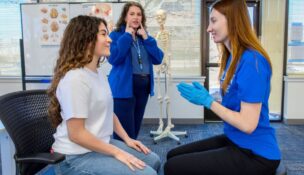
William McPhee, president and CEO of MacuLogix, said the new headquarters will allow the company to better showcase the sight-saving device. It has an on-site testing room where MacuLogix can demonstrate it.
Jackson said he’s thrilled with how things have taken off over the past few years and he’s hoping that many more eye care professionals will begin using the machine to diagnose AMD.
“It’s quite humbling and exciting to see the company I co-founded more than a decade ago experience such exponential growth in the past few years and we are proud to be officially headquartered in the capital of our home state,” he said.