Sign In
Upcoming Event
 Free Newsletter


York County Economic Alliance President & CEO Kevin Schreiber. PHOTO/PACAST
2025 in Review: Pa. proves what’s possible amid national uncertainty


 Listen to this article
Historic investments, economic momentum, and strain on businesses were part of Pennsylvania in 2025.
Such is the consensus of PA Chamber President and CEO Luke Bernstein, Harrisburg Regional Chamber & CREDC President and CEO Ryan Unger, and York County Economic Alliance President & CEO Kevin Schreiber.
“In 2025, Pennsylvania proved to ourselves — and to the rest of the country — that we have what it takes to compete for major projects,” Bernstein said. “We saw historic investment announcements, long-debated policy changes move forward, and a renewed focus on making our state more competitive.
“Pennsylvania is closing out this year with more economic activity, more national attention, and even more reasons for employers to feel optimistic about the direction our commonwealth is heading.”
Bernstein noted the $10 billion plan to convert the Homer City Generating Station, once home to Pennsylvania’s largest coal-fired power plant, into a natural gas-powered data center campus; Amazon’s intention to invest at least $20 billion to establish high-tech cloud computing and artificial intelligence innovation campuses across Pennsylvania; and the Pennsylvania Energy and Innovation Summit and the $90 billion in private investment commitments tied to AI, advanced manufacturing, and companies building the next wave of technology.
“Policy progress helped make this momentum possible,” said Bernstein. “After years of employers asking for a faster, more predictable permitting process, we finally saw meaningful steps to speed up decisions and give companies clearer timelines.
The Department of Environmental Protection eliminated its permit backlog and implemented major improvements under the SPEED program, and the 2025-26 state budget takes additional steps to expand these permitting efficiencies and puts accountability metrics in place to ensure that state government is operating with added transparency and efficiency.”
Bernstein cited the state’s withdrawing from the Regional Greenhouse Gas Initiative, and pro-business tax reforms as helping Pennsylvania to be recognized as having the 11th best business climate in America in Site Selector Magazine’s rankings. Pennsylvania is the lone state in the northeast with a growing economy.
“Pennsylvania enters 2026 with more momentum than we’ve had in a long time,” said Bernstein. “There’s more work ahead, but this year is proof that meaningful progress, even in a divided government, is possible when we stay focused, move with urgency, and make decisions that strengthen Pennsylvania’s ability to compete.”
Schreiber called 2025 “a defining year for York County,” and one marked by economic momentum, collaboration, and deliberate strategy amidst national uncertainty.
“Despite challenges such as labor shortages, elevated construction costs, continuing inflation, and fluctuating consumer confidence, York demonstrated resilience and continued to position itself as a statewide leader in innovative and data driven economic development,” said Schreiber. “Our York County Economic Alliance team supported approximately $612 million in capital investment, covering everything from corporate expansion, nonprofit redevelopment projects, small business lending, job creation and commonwealth grants supporting brick and mortar projects for private, public, and nonprofit organizations.”
Schreiber said housing remained a core priority across the region, and York advanced several key recommendations of its cross-sector Housing Action Agenda. He noted that workforce development evolved towards more strategic talent development and retention and also cited regional initiatives such as the Talent & Innovation Defense Ecosystem and The Every Child Has Opportunities Initiative. He also noted the United Way of York County’s Transportation Innovation grant that is the first of its kind in South Central Pennsylvania.
“York’s entrepreneurial and small business support systems also shined,” said Schreiber. “BLOOM, Finanta, Assets, and White Rose Ventures all supported small business growth through outlay of capital and wrap around support.”
Since 2020, York’s Economic Action Plan has seen a 39% growth in new small businesses, a 104% growth in minority-owned businesses, and 37% growth in women-owned businesses, exceeding state and national averages.
Schreiber highlighted York’s York County Trail Towns program, and the county’s support of the Outdoor Business Alliance of Pennsylvania. Investments continued in in infrastructure progress and leadership, and a new Nonprofit Collaborative provides training to nonprofits.
“Taken together, 2025 was not only a year of progress, it was a year of positioning York County for a brighter tomorrow,” said Schreiber. “We enter 2026 with the strategic clarity and foundational investments necessary for transformational growth.”
Unger reflected on “a year of meaningful progress.” Over 120 businesses joined the chamber in 2025, the second straight year of net membership growth and the strongest membership numbers in more than a decade. The chamber welcomed 5,200 members and guests to events throughout the year, and 90% of attendees reported leaving with a business connection.
Unger said the economic development team at CREDC produced record loan volume while managing the largest portfolio of grants in the organization’s history, supporting projects across Cumberland, Dauphin, and Perry counties.
“Those investments are visible all around us—from a new coffeehouse in Camp Hill to a pipe manufacturer in Steelton to a hatchery in Perry County,” said Unger. “These projects represent more than transactions; they are signs of confidence in our region’s future.”
“Economic and population data consistently show that we live and work in one of the fastest-growing regions in Pennsylvania,” said Unger. “That growth is driven by the residents, entrepreneurs, and community leaders who continue to invest their time, talent, and capital here.”
Business and professional services, education and health care, and information technology remain strengths of the regional economy. Many of these jobs are done remotely or in hybrid fashion, reshaping how and where people work.
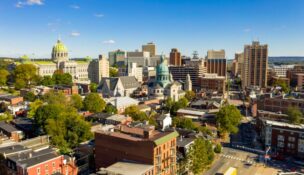
“Nowhere is that shift more visible than in downtown Harrisburg, the historic and economic heartbeat of our region,” said Unger. “Since 2020, foot traffic in the capital city has declined by approximately 25 percent. That change has placed real strain on businesses that made long-term commitments based on very different assumptions. The fundamentals have shifted, and with that shift comes a responsibility to rethink the future of our downtown.”