Sign In
Upcoming Event
 Free Newsletter


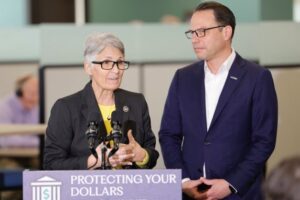
Governor Josh Shapiro presented his 2025-26 budget proposal Tuesday to the General Assembly. PHOTO/PACAST
Shapiro unveils 2025-26 budget; draws mixed reviews


Declaring that “Pennsylvania is on the rise,” Governor Josh Shapiro on Tuesday unveiled his 2025-26 budget proposal.
The governor’s 91-minute address drew mixed reviews in the General Assembly, prompting optimism from his fellow Democrats and a guarded response from Republicans.
“Pennsylvania is on the rise, and this budget is a clear roadmap for tackling our challenges and building on the bipartisan foundation we’ve created over the last two years,” Shapiro said. “My budget proposal is focused on solving problems for Pennsylvanians, expanding our workforce, cutting costs, investing in public safety and economic development – and so much more – to keep creating more opportunity for all Pennsylvanians.”
The governor spent a third of his speech praising the bipartisan agreements reached by the state’s divided House and Senate. Shapiro stated his budget is designed to cut costs for health care, housing, and energy; spur economic growth; strengthen public safety; fund education; and make Pennsylvania more competitive economically. The proposal emphasized workforce development; investing in economic development; and maintaining bipartisan efforts to support students. In addition, Shapiro spoke of maintaining a balanced budget and cutting taxes and eliminating red tape and duplicative government programs.
“This budget strikes a balance by making historic investments while maintaining fiscal responsibility, continuing to cut taxes, and ensuring our commonwealth’s surplus remains strong while we keep moving Pennsylvania forward,” Shapiro said. “By working together with Democrats and Republicans in the General Assembly, we will continue to tackle the challenges we face and drive growth for a stronger, more prosperous Pennsylvania.”
Lieutenant Governor Austin Davis said the budget proposal is pro-Pennsylvania.
“Over the past year, I’ve been honored to meet with Pennsylvanians who are getting stuff done in their communities — people who are working to make their neighborhoods safer, teachers who are educating our youngest learners, advocates that are fighting for victims’ voices to be heard,” said Davis. “This budget shows we have their back, by investing more in afterschool programs that help keep kids safe and expand their horizons, more in community-based organizations that are addressing gun violence, more for early childhood education and childcare and more to support victims of crime.”
Republicans responded with statements calling for a more responsible and realistic budget proposal.
“Today, the governor unveiled a massive, $51.47 billion spending plan that, unfortunately, fails to address many of the issues important to 88th District residents,” said State Rep. Sheryl M. Delozier (R-Cumberland). “This proposal increases spending by a whopping 7.5% over last fiscal year, a rate we simply cannot keep up with.
“If enacted, this budget would deplete the remaining $2.89 billion General Fund surplus the General Assembly has worked hard to create in prior budget cycles; and it would require transferring $1.6 billion from the Rainy-Day Fund to balance.
“Thankfully, this is just a starting point. Now that we’ve heard the governor’s wish list, the hard work of creating a more responsible budget can begin. Over three weeks, the House Appropriations Committee will hear testimony from state agency leaders about their funding requests and we will work toward a compromise.”
Rep. Torren Ecker (R-Adams/Cumberland) said that while there are some elements he can agree with, he cannot support the overall proposal because it sidesteps deep-seated spending issues.
“Relying on new taxes from legalizing marijuana is not a bold step toward fiscal responsibility, it’s a risky gamble designed to create a new revenue stream without addressing the runaway spending that has burdened Pennsylvania for too long,” said Ecker. “Furthermore, legalizing marijuana opens the door to numerous challenges for our residents. Under federal law, marijuana remains illegal, meaning that users could lose their legal right to purchase or own a firearm. Even with legalization, employers would still be allowed to test for marijuana and take punitive action against those who use it, potentially jeopardizing the livelihoods of hardworking Pennsylvanians.
“Now is the time for a budget that honors taxpayers and funds the core functions of state government. As a member of the House Appropriations Committee, I am committed to forging a fiscally responsible plan that truly works for Pennsylvania.”
Rep. Wendy Fink (R-Red Lion) said the General Assembly will begin the work of negotiating a responsible plan that can meet Pennsylvania’s needs while remaining stewards of taxpayer dollars.
“Shapiro shared with us his concept for a massive $51.47 billion budget,” said Fink. “This represents a 7.5% spending increase from the current fiscal year. If adopted, his proposal would deplete the $2.89 billion General Fund surplus and require transferring $1.6 billion from the Rainy Day Fund to balance.
“Shapiro’s budget plan would put the commonwealth at a crossroads. We must either work together to generate the economic growth needed to fund these spend-heavy plans, or the cost will get passed along to taxpayers who are already struggling to meet the cost of living. This is unacceptable. Furthermore, the governor’s plan does nothing to address the growing concerns of a looming fiscal cliff, which has been predicted by economists for years.
“When I took office in 2023, the budget incorporated $45.55 billion in planned spending for that fiscal year. In just three budget cycles, the proposed spending has increased by nearly $6 billion. When will it stop? Where will we draw the line?
“I am looking forward to diving deeper into the budget in the coming weeks to develop a more reasonable plan that funds everything Pennsylvania needs, and nothing it doesn’t. We need to work together toward a responsible budget, or I will be a firm ‘no’ for my constituents in District 94 who cannot afford, and do not want to see their government enact this level of spending,” said Fink.
The House Appropriations Committee will begin a series of hearings starting Feb. 18, to examine Shapiro’s plan and how state departments and agencies are spending their funding. The General Assembly and governor have deadline to finalize the budget by June 30.