Sign In
Upcoming Event
 Free Newsletter

Community First Fund, O’Pake Institute partner on Berks microloans

The Community First Fund and The O'Pake Institute formalize their collaboration. PHOTO/COMMUNITY FIRST
Community First Fund, O’Pake Institute partner on Berks microloans


 Listen to this article
With one of its offices sharing a building on the Alvernia University campus in Reading, Lancaster-based Community First Fund and the O’Pake Institute have had a long history of collaboration.
But now the two organizations have formalized their collaborative efforts in an attempt to bolster access to microloans in Berks County – particularly to lower-income areas in Reading with large populations of minorities and immigrants, that often don’t have access to traditional banking services.
As a Community Development Financial Institution (CDFI) Community First specializes in business lending including small business loans, commercial real estate and affordable housing.
Most recently it was involved in the effort to help a Lehigh Valley manufacturer< Marcon Properties purchase new manufacturing and warehouse space for its Eastern Exterior Wall Sytems at a brownfields site in Allentown using New Market Tax Credits. The project is revitalizing a blighted 17.5-acre manufacturing campus off 10th Street in the city.
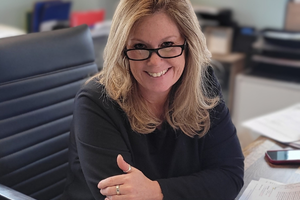
But sometimes it’s the smaller businessperson that’s in need of help, said Alba Fernandez, senior vice president of Lending for Community First Fund.
“With this effort we are trying to provide capital and resources to communities with a higher concentration of low income, people of color, women and immigrants,” Fernandez said. “We look at how impactful it will be not just for the individual, but for the community.”
Working with a partner like the O’Pake Institute helps complete the circle of services many of these small businesspeople, or aspiring entrepreneurs need to grow or start a business.
That means making sure that those coming to Community First seeking loans have a more rounded idea about what they’ll need to make their business idea work.
“We work with a lot of partners, small business development centers, chambers of commerce and university. A lot of this work can’t be done by just one organization. It really takes a village,” Fernandez said.
Community First is focusing this effort on microloans, which may be as low as $1,200, but provide vital capital to help a small business.
But, sometimes, Fernandez said an individual will come to them wanting to – for example – open a small ethnic food restaurant, but they know how to make food and not necessarily how to run a day-to-day business.
“They often come to us and say I have a business idea I want to get off the ground, but I don’t know how to go about it, and I need money to do it,” Fernandez said. “Our job is to line them up with the information by referring them to the O’Pake Institute.”
She said before Community First talks to them about getting a loan, they want to make sure the person knows what they’re getting into.
O’Pake can help them with things they need to know from something as simple as making a business plan to marketing opportunities, financial projections, locations and leveraging other resources.
With that knowledge in place, the potential borrower will have a stronger sense of what they need in financial help.
Fernandez noted that it also works the other way. Oftentimes people will seek out the guidance of the O’Pake Institute to learn about getting or growing a business and then O’Pake will introduce them to Community First to help with Financing.
She said there is a strong need across the state among low-income people who don’t have access to traditional bank loans whether it’s because of bad credit, lack of collateral or inexperience.
Currently, she said 60% of Pennsylvania residents are either underbanked or unbanked and those are the people that need their help.
In a city like Reading, which has such a strong concentration of low-income individuals, she hopes that expanding the microloan program will help build stronger communities and help bring wealth to the city.